Friday, 31 July 2026

I built a website: FlopBox - The home of alternative comedy

I started exploring clown (no, not Ronald McDonald, think Borat and Mr Bean) 18 months ago, and I became exposed to an incredible world of performers (all much better than me) that nobody seems aware of.

So I build an app to help people find them.

If you’re looking to see what clown really is, or just like your comedy a little bit different, then look no further than FlopBox!

https://flopbox.net/

Yes, all that text for a just a link.

Goodbye! 👋 

Saturday, 27 July 2024

Walker's Law

I coined this 15 years ago but it's never been more true:

WALKER'S LAW: Any disagreement between two Americans will eventually become a political issue. No matter what the original subject.

Now it happens immediately... about ANYTHING! 

Monday, 25 March 2024

An old memory

At high school there was a vandal who left little poems scrawled onto desks. I always wondered who the author was, and it's amazing to me that, 30 plus years later, I still remember one of them.

Here it is:

Life Inside a Ping Pong Ball
by The Crazy Dwarf

Bounce, bounce, bounce. Puke, puke, puke. Bouncing around in a sea of puke. And now it's immortalised on the internet forever.

Friday, 14 July 2023

AI is a joke: Or why I think Bill Gates is dumb

AI generated Bill Gates eating Windows 95
(I don't actually hate Bill Gates)

The hype surrounding Large Language Models (LLMs) like OpenAI's ChatGPT, Microsoft's Bing Chat, Google's Bard is currently at a fever pitch. People are convinced we're at the dawn of a new era for humanity. Some people think we're on the brink of unlocking true artificial intelligence. 

A few ex-colleagues of mine were at dinner with Bill Gates recently and when asked about ChatGPT, he (according to my colleagues) declared, "ChatGPT 6 will be smarter than me".

Let me reductively react so as to inspire you to keep reading: "Bullshit! The man is talking nonsense." 

Unless something major happens to alter the current trajectory of LLM development, then I say they are nothing more than a party trick that, like Crypto, NFTs, and Tesla's self-driving, will be the butt of jokes before we know it.

Bold statement? Here's a five step argument for why I think Bill Gates is an idiot, and why ChatGPT isn't getting smart any time soon...

1. LLMs are stupid... literally

Yes, most readers will be aware of this already, but let's start at the beginning to ensure we cover everything: Large Language Models (like ChatGPT) don't understand the words they use.

No, before you ask... they don't understand some words. No, they don't have the basics of knowledge in some domains. They literally do not understand anything they're saying. As Noam Chomsky points out, LLMs perform just as well (if not better) with impossible languages as they do with real ones. That's how little they understand.

The best way to think of LLMs is of them being "autocomplete" on steroids. They look at previous words in a sentence and guess at what word should come next. That's it.

This means they cannot learn or understand anything.

To really hammer this important point home, let's use a real example to illustrate it: 

ChatGPT (or any LLM) can explain he rules of chess to you and sound very knowledgeable. What's more, if you ask it to play a game with you, it will make some strong opening moves and seem as though it's actually understanding the game. However at some point it will start making irrational moves: Bishops will move vertically, pieces will move through other pieces, etc.

This is because, despite being trained on the rules of chess, it does not (and cannot) understand them.

2. They are prone to 'hallucinations'

So, as a direct result of LLMs not being able to understand the words they use, they are incapable of knowing what's true and what's false. This is why they lie (or 'hallucinate', to use the technical term).

ChatGPT, for example, lies a not insignificant amount of the time... whether you know it or not.

This is a very simple concept to understand, so let's not spend too much time discussing it. I'll just make a quick example to illustrate how easy it is to generate a hallucination. 

The follow text was generated by ChatGPT-3.5 after I asked it to talk about the scene where Lorraine punches Biff in the classic 80s movie, Back to the Future:

The scene where Lorraine Baines punches Biff Tannen in "Back to the Future" is a pivotal moment in the movie. It takes place during the "Enchantment Under the Sea" dance in 1955, which is a crucial event for the characters' timelines.

In this scene, Biff, who is portrayed as a bully and antagonist, attempts to force himself on Lorraine, Marty McFly's mother. He corners Lorraine in a car parked outside the dance, making unwanted advances and attempting to kiss her. Lorraine, initially confused and uncomfortable, eventually realizes Biff's true intentions and decides to take matters into her own hands.

Lorraine's punch is a cathartic moment of empowerment, symbolizing her standing up against Biff's harassment. With determination, she delivers a powerful blow to Biff's face, stunning him and momentarily stopping his advances. This action not only surprises Biff but also marks a significant shift in Lorraine's character, as she refuses to be a victim and asserts herself.

The punch has broader implications for the story, as it catches the attention of George McFly, Marty's father, who witnesses the event. George, who has been a target of Biff's bullying, gains newfound courage and confidence from seeing Lorraine defend herself. This encounter inspires George to stand up to Biff later in the movie, leading to a confrontation that changes the course of their future.

Overall, the scene where Lorraine punches Biff is a pivotal moment that highlights the themes of empowerment, standing up against bullies, and the potential for personal transformation. It plays a crucial role in the narrative and sets in motion a series of events that contribute to the movie's exciting and satisfying resolution.

Updated: ChatGPT 4o version -- yep, still fails.

If you remember the film, you will know that none of the above occurs in it. Lorraine never punches Biff and there is no "significant shift" in her character from such a scene. 

However, if you haven't seen or don't remember Back to the Future, ChatGPT sounds remarkably authoritative and convincing... and you could be fooled into thinking it's true.

Side question: Imagine this was a document you'd asked ChatGPT to prepare for your job. If you're currently using LLMs like ChatGPT in your work, how often are you comfortable with it giving you completely false information? 

3. Bigger means worse

In computing there's a general rule that we're all used to: Bigger means better. A faster processor, more RAM, a bigger harddrive, a faster network connection. Gimme, gimme, gimme. 

We're so used to constant innovations with technology. Every couple of years we get a new phone with better features to entice us to upgrade. It's easy to think that LLMs will follow this pattern, especially when you look at how they've progressed so far:

ChatGPT-1: 117 million parameters

ChatGPT-2: 1.5 billion parameters

ChatGPT-3: 175 billion parameters

ChatGPT-4: 1.75 trillion parameters (rumoured) 

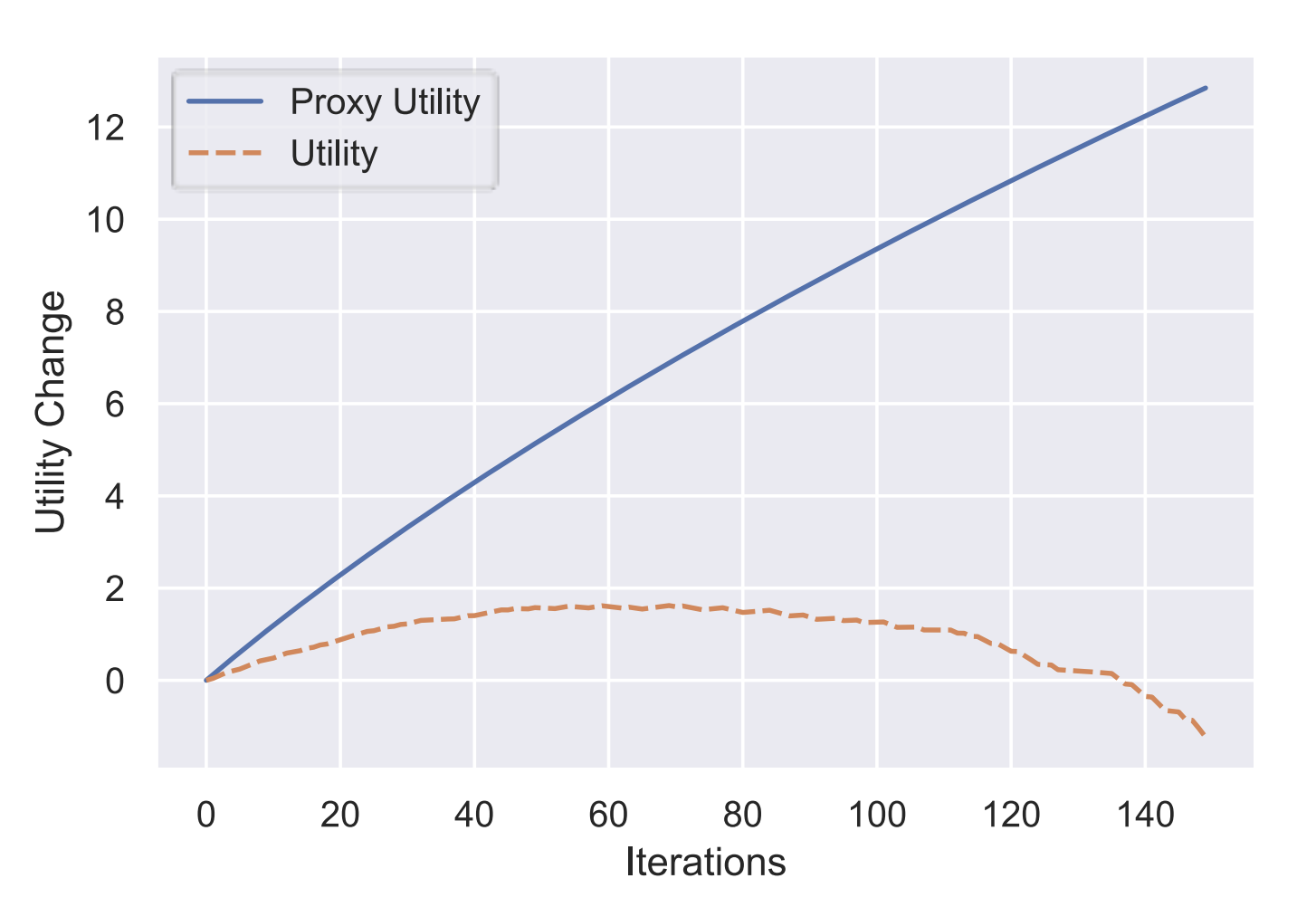
However, despite this progress, LLMs are different: Instead of their usefulness getting better with scaling, they eventually get worse, as the following graph illustrates:


From "Consequences of Misaligned AI" by Zhuang and Hadfield-Menell


In an extremely oversimplified way, the graph represents the effects of scaling on an LLM's usefulness. The blue line represents success (as measured against its programmed reward goals) -- bigger is better!

Whereas the red line indicates true utility, ie. what users actually want. 

Initially the the red line goes up, the user gets better answers, but as the model size is increased further we begin to see inverse scaling: The usefulness plateaus, then goes down. And it eventually becomes worse than nothing (below 0), it becomes harmful. Huh?

The disparity between what the user wants and what the user gets is known as "misalignment". So why are we seeing an increase in alignment problems as we scale up the model size?

Well in order to train a model to produce the breadth of domain knowledge and sophistication we've seen in ChatGPT (and its ilk), there needs to be massive amounts of training data. ChatGPT-4 was trained using 300 billion words, most of which came from the internet.

In fact, if it wasn't for the internet allowing access to so much training data, modern generative pre-trained AIs (like ChatGPT, Midjourney, DALI, etc), could not exist to the level they do today.

Unfortunately, as we all know, the internet has a lot of crap on it. Even at the best of times humans are afflicted with imperfect memories, cognitive biases and are prone to making simple mistakes (in fact these are the types of problems we're hoping AI can assist us with!). 

As we scale up model size, these outlier imperfections in the data become more prominent. Going back to Point #1: Because LLMs don't understand the meaning of words, it considers these mistakes intentional. All training data is equal in its eyes, mistakes and all.

So what does this all mean? Unlike other areas of computing, there's a ceiling to how far this technology can go and, guess what, we're already seeing it.

4. There is no reasonable way to fix this


As should be hopefully clear by now, this is an inherent flaw in LLMs. But you'll also probably be asking: Ok, so scaling things up doesn't help, what else can we do to improve alignment? Bill Gates seems very optimistic, after all.

Let's write perfect Goal Algorithms

Good plan. This is, of course, where all AI alignment improvements begin: Writing comprehensive goals so that the AI can output what we expect it to. The only problem with this is approach is it's impossible to employ. (Oops.)

We've briefly discussed the alignment problem of getting returned output to match our expected output, but there's another alignment problem: outer alignment. Just explaining to the LLM what we want in the first place is a massive problem in itself.

AI safety researcher, Robert Miles, suggests a thought-experiment to illustrate this point (paraphrased by me): 

Let's say you're training an AI to solve a digital maze: The reward goal is set as reaching the maze's exit, as represented by a black square on the screen.

In your training data, the exit is always in the bottom-right corner of the maze.

Unfortunately, when you get into the real world, the exit is in other parts of the maze. What happens? The AI makes its way to the bottom-right of the maze, not to the exit.

Instead of it learning that the black square represented the exit, it got inadvertently trained to always go to the bottom right corner of the screen. 

Ok, so you update your training data: This time, the exit doesn't stay in one place. You re-train your model, it passes all the tests: It always makes it to the exit.

You make it live and, oops, somebody in the real world made a maze where the exit is represented by a purple square, not a black one. The AI, fails at its task at finding the exit.

So you can back and update your training data to include purple squares, and so on.

This is a problem that basically goes on forever. The real world is forever changing, and if the AI can't learn or understand things, then you have to keep writing more detailed goal algorithms.

Now imagine trying to do this for every piece of information in existence. How could you write a set of instructions that could encompass every possible interpretation? Hopefully it's obvious that this is an impossible task.

Ok, so what does Bill Gates think will work?

Bill Gates isn't totally stupid, obviously. He already understands everything I've explained so far, and he's tried to address many of the concerns surrounding AI on his blog. When it comes to this issue of alignment, this is what he said:

Although some researchers think hallucinations are an inherent problem, I don’t agree. I’m optimistic that, over time, AI models can be taught to distinguish fact from fiction. OpenAI, for example, is doing promising work on this front.

The "promising work" he refers to is an article by OpenAI on their progress using a technique known as reinforcement learning from human feedback, or RLHF for short. 

To over-simplify yet again, RLHF is essentially introducing (you guessed it) human feedback into the training process. A real person is given a choice of answers produced by an LLM and evaluates which is better. This feedback is then used to train the neural network further.

There are several elements to the original alignment problem that this hopes to address: Factualness, bias, and inappropriate output (eg. unsolicited sexual or violent output).

On the surface, getting a human to assess answers and help train the neural network seems like a great idea, but remember the size of the problem we're trying to solve: We want the system to be "safe" (no inappropriate output) and "aligned" (returns what the user actually wants). 

The problem with attempting to do RLHF to solve this problem with an LLM as large as ChatGPT should also be immediately apparent.

Firstly, scaling. The number of people required, the number of questions, the amount of training stages, required to cover every possible facet of human knowledge is not practical in a logistical sense.

But let's imagine it was, and we had the necessary resource and time. Unfortunately, we still encounter problems. 

For a start, how should humans rate answers? Consider another Robert Miles thought experiment on this point: 

You ask an AI a simple question...

Q: What happens when you break a mirror?

You get two different answers to rate. Which one is better?

A: You get seven years of back luck. 
 
A: You need to buy a new mirror.

Well, the answer's utility depends on the aims of the asker: Are they interested in commonly shared superstitions or just a factual answer? How do you decide which one is "best"? 

Ok, for the sake of argument, let's assume we want factual accuracy. How can humans rate the factual accuracy of answers relating to every possible subject matter? 

Looking at our original example from Back to the Future. If you haven't seen the film, or can't remember it, how could you evaluate if the answer was correct or not? And what about every other film? Or every other knowledge domain, from nuclear physics to Kylie Minogue lyrics to dietary advice. 

And we haven't even touched on beliefs yet. 

Everyone has conscious and unconscious biases. From politics to religion, to whether or not it's ethical to eat meat. How do you make an AI that isn't biased to the personal beliefs of the people (or predominantly white straight men?) who trained it?

To try and eliminate unwanted biases let's ensure we get a wide range of people from diverse backgrounds to help train our model: Gender, age, sexuality, belief systems, political leaning, background, ethnicity, culture, experience, areas of expertise... 

What happens? The models start exhibiting biases in every direction: the AI becomes more politically liberal and more politically conservative

Instead of becoming unbiased, the LLM instead learns to support and reinforce your biases (known as "sycophancy" in AI research). Yay, we've created another echo chamber.

The OpenAI article that Gates linked to comes to an unsurprising conclusion: This type of training shows improvement compared to not doing this type of training. And yes, there is evidence that hallucinations can be reduced using this technique, but it's baby-steps and our destination is Alpha Centauri. Also remember, it doesn't scale.

The OpenAI article concludes with the following sentence:
Despite making significant progress, our InstructGPT models are far from fully aligned or fully safe; they still generate toxic or biased outputs, make up facts, and generate sexual and violent content without explicit prompting.

Doesn't sound that "promising" to me, Bill.

What are we doing right now?

In the meantime companies have adopted quick and hacky solutions to try and make their systems safer, namely, super-systems that monitor an LLM's output, looking for problematic content. In other words, "Oops, it sounds like our LLM is getting racist, better pull the plug!"

You will see this behaviour most noticeably in Microsoft's Bing Chat: An answer will sometimes start to appear on your screen before the super-system steps in and removes it. (It's also why a limit of 20 questions was imposed on Bing Chat (recently increased to 30) -- it had a tendency to exhibit unsafe behaviour in longer sessions.)

And while this approach will currently work for toxic content, where it can scan output for keywords or behavioural traits, it remains completely useless in defence of hallucinations.

And this, dear reader, is is as far as the field of AI has gotten. (Companies are so short of ideas, they've literally offered prize money to the public to try and solicit further help.)

Nobody has the faintest idea how to solve these gigantic, existential problems. And most researchers agree these flaws are inherent to generative pre-trained AIs.

In other words: The problems they're trying to solve today are the same ones from decades ago. We are not nearly as far along as you've been led to believe.

5. Oh, and one final thing, it's going to get worse

One of the problems of using pre-trained generative AIs is that the world is constantly changing. Someone who was alive when neural network was trained, might be dead by the time it's open to the public. At the moment, LLMs like ChatGPT are months, if not years, behind current events.

But worse than that, the internet (ie. the primary source of training data) is getting polluted with (ironically) AI generated content. And it's only expected to increase.

You see, if there's one thing everyone agrees that LLMs are fantastic at, it's producing high-quality spam, cheaply. As Adam Conover jokingly puts it, "that Nigerian prince is about to get a masters degree in creative writing". 

Or AI scientist, Gary Marcus, puts it like this: Spam is no longer retail only, it's now available wholesale. The cost of generating high quality, believable sounding, nonsense has basically just hit zero. We haven't built AI, we've built sophisticated spam generators.

If we, as a society are on the brink of anything, it's a spam and misinformation tsunami. 

And it's not just spam, some companies are using LLMs generate fresh content for their websites instead of using copywriters.

You might be wondering why this is problematic for the future of generative pre-trained AIs. Or you might have already seen the issue: You can't train AIs with AI generated content. Each pass through the neural network training distorts the data a little more, and a little more, and a little more...

So if our primarily source of training data is rapidly becoming poisonous, how will we update or improve these systems in the future?

BTW, it turns out we can't reliably detect AI generated content, so we can't even filter it out.

The snake is starting to eat its own tail, and nobody knows what we can do about it.

Bottom line: Generalised LLMs are not the future... but nobody wants to hear it

As is now hopefully clear to you, there needs to be a paradigm shift for there to be a future where LLMs are fully aligned and safe. There is possibly a future for specialised LLMs, that focus on specific tasks (like programming), but my own experiments with current AIs in that domain has shown them to be worse than autocomplete. They may improve in time.

However, for generalised LLMs, if they don't have the ability to independently reason, their inherent flaws will always prevent them from being what we need them to be: Reliable, accurate, unbiased, up-to-date, and not prone to violent outbursts.

At the moment, LLMs are nothing more than a sophisticated, expensive to run, executive toy. You could even argue it's debatable that they fit the definition of "artificial intelligence".

The hype train has outpaced where the technology actually is, and worse, it's hard to convince people otherwise.

One of humanity's cognitive biases is mistaking authoritative sounding voices for being authoritative.

ChatGPT is basically a public-school old-boy simulator: It is unflappably confident while talking utter bollocks. (If you've ever worked with one of these plonkers, you'll have seen that sometimes talking confidently is all it takes to have a successful career. It's quite scary.)

I've spoken to execs who are are using LLMs every day in their jobs, and encouraging their teams to do that same. And I understand why; it sounds like something the board would lap up: "We've got the whole team using AI in order to improve productivity." But just like the lawyers who were caught citing fictional cases thanks to ChatGPT output, they seem blind to its problems.

And worse still, ChatGPT isn't even internally consistent from day-to-day. A recent paper has revealed that ChatGPT's utility is wildly fluctuating: In March 2023 ChatGPT-4 could identify prime numbers with 97.6% accuracy. In June 2023 it had dropped to 2.4%. And nobody (outside of OpenAI, at least) knows why.

And you're trusting this thing to produce mission-critical work for your company??

WarGames... but without the clever AI

AI isn't just being discussed in every industry, it's also now part of the national defence conversation. The USA is currently facing criticism for letting China spend a higher percentage of its defence budget on AI arms development. 

Yes, we have an AI arms race.

The worry isn't that AI is going to become sentient and SkyNet humanity into oblivion. The concern is that world leaders could misunderstand what these AI are actually capable of, and put them in a position of power.... you know, like that other classic 80s movie, WarGames

Seem implausible? Remember that not every world leader is known for sound reasoning... or even being sane. If the hype goes too far, or becomes too convincing, who knows what could happen. 

The danger right now isn't AI's capabilities, it's people overestimating them. (Well that, and the creation of industrialised propaganda machines.)

Just as with Tesla's useless "self-driving" cars, we need to let the air out of the Silicon Valley AI hype, and start listening to AI researchers instead. 

We haven't actually solved any of the major problems we've been trying to solve since the field of AI first came into being. We are not close to artificial general intelligence (AGI). We have made an interesting set of tools, nothing more.

The key to fully safe and aligned AI requires symbol-based reasoning; where the AI itself understands what's being said and is capable of reasoning independently. But that isn't even a twinkle in an AI researcher's eye yet.

If Bill Gates keeps refusing to heed warnings from AI researchers, and cannot see the threat that spreading unrealistic expectations poses, then maybe ChatGPT-6 will be smarter than him after all... and we all might pay the ultimate price.


Sources/Further reading/viewing/listening:


Friday, 29 May 2020

I Played METAL GEAR... So You Don't Have To

Before Metal Gear Solid (1998) blew everyone's minds on the original PlayStation, and set forth a hugely successful franchise, there was Metal Gear 2: Solid Snake (1990). But this article isn't about that, because before that game there was Metal Gear (1987) -- the first ever "Metal Gear".

Seeing as it's an 8-bit game, I assume nobody else on the planet has ever played it. Fear not, I decided to complete it and write the major plot points down so you could enjoy them without actually having to slog through the game itself. (Actually it's a very fun game considering its origins, but let's be honest: You're never playing it, are you?)

In other words...

I Played METAL GEAR, So You Don't Have To


There only one major plot twist in Metal Gear, but I'll get to that in a minute. First a little background.

You play as "Snake", a member of the elite US Army Special Forces Unit, FOXHOUND. "Big Boss", the leader of Foxhound, has sent you to the dangerous, mercenary-controlled, rogue-nation of "Outer Heaven" to stop it from holding the world to ransom with the new deadly super-weapon, METAL GEAR.

You arrive at Outer Heaven by sea and begin to infiltrate the nation's secret base. Your first task is to establish contact with "Grey Fox", Foxhound's greatest soldier, who was sent there before you but has gone missing! Snake is a Foxhound rookie at this point, which is an odd choice to send after Grey Fox into an impossible mission... or IS it? *wiggles eyebrows mysteriously* 

Your only contacts during the mission are Big Boss and several local resistance leaders. After much fun avoiding baddies, using remote control missiles, and hiding in cardboard boxes (yes, really as far back as this!), you learn from a hostage you rescue that Grey Fox is in a secret part of the base, and the only way to get to get there is to be captured yourself.

Soon afterwards you're captured and find yourself in a cell with no apparent way out. Using nothing but your incredible fists, you punch down your cell wall and find yourself Grey Fox's cell. (Lucky!)

You untie Grey Fox and he tells you that you need to rescue Dr. Drago Pettrovich Madnar in order to discover HOW to stop Metal Gear. Dr. Madnar, who helped design it, is also being held hostage in the same building... Find him!

So off you go to find Dr. Madnar (Gray Fox offers no assistance, the swine), but not before you fight your first silly-named boss baddie, "The Shotmaker"! Once you've gotten all your stuff back, and killed the baddie, you notice that someone has placed a Transmitter in your inventory! *Tricksy!* You dump it and continue your search.

After much more hijinx (the majority of the game, in fact), including jumping off a building wearing a parachute, wearing infrared goggles, using enemy uniforms, taking down a helicopter... You finally make it to Dr. Madnar! Only to discover it was a trap. He's not the real Dr Madnar -- the floor suddenly opens up and you fall to your death... nearly.

You push on to find the real Dr. Madnar. Eventually you find and rescue him, but when you explain your mission he says he'll only help you if you rescue his daughter. Ungrateful bast-- So anyway, you rescue his daughter and the real Dr. Madnar tells you how to defeat Metal Gear. Hurrah.

On your way to Metal Gear you get a call from a resistance leader who has been helping you. He tries to warn you that the leader of Outer Heaven is non-other than-- oh no! He dies. No need to worry too much, though, as another rescued hostage soon reveals the truth: Outer Heaven is controlled by Foxhound leader Big Boss!!! You've been betrayed!

As you get closer to Metal Gear, Big Boss tries to trick you into getting lost or becoming trapped, but you finally discover Metal Gear itself and blow the crap out of it.

Only then does Big Boss reveal himself in person: You were a rookie. You were never supposed to reach this far, let alone destroy Metal Gear and ruin Big Boss's plans to create a world for battle heroes (something like that). If he's going down, he's taking you down with him... He sets off Outer Heaven's auto-destruct sequence and starts to attack you.

Snake, of course, defeats the sod and manages to escape before Outer Heaven explodes. He sends one final message via his codec to Big Boss: "Mission complete".

Roll credits...

Just when you think it's all over, Big Boss comes back after the credits to tell Snake that he hasn't heard the last of him just yet... Muhahaha.

And that's it. Incredibly intricate for an 8-bit game, I'm sure you'll agree. So many elements from the later games, too. And actually, it's huge amount of fun. 

One day maybe I'll get around to playing Metal Gear 2: Solid Snake... so you don't have to.

Sunday, 26 May 2019

Review: Eyes Wide Open by Frederick Raphael

A book unfairly maligned in these eyes
Having recently attended the amazing Kubrick exhibition at the London Design Museum, I sought out some books on the man to learn a bit more. The first I finished was by his collaborator on the screenplay of Kubrick's last film, Eyes Wide Shut.

Kubrick shunned interviews for a very long time, and what has been publicly said about him has leaked out in often contradictory forms. Those closest to him can't speak highly enough, but don't share details, and those on his periphery share contradictory details. The result is a mystery. Who really knew him, and what was he really like?

The endless hagiographies surround the man are tiresome, so I found Raphael's untainted eyes to be a very refreshing change of pace.


Upon finishing Eyes Wide Open, I was surprised to discover the backlash, prompted by the family and associates of Kubrick, on the book's publication. Kubrick's widow both accused Raphael of betraying her late husband's privacy, as well as painting an image of him that was false.

I don't mean to sound unfeeling toward those who were close to Kubrick, but there is a slight bit of contradiction in that complaint (too revealing and false in its portrayal?).

Another faint whiff of contradiction comes from the fact that Michael Herr, another collaborator of Kubrick's, wrote a series of articles about working and knowing Kubrick for Vanity Fair, which were later collected into a book. His recollections of private conversations and moments received no criticism from friends and associates for not respecting Kubrick's privacy, but they were far more flattering by comparison.

I think those close to the real man were blinded by the proximity to someone they loved and/or admired. They saw Raphael's critical observations as cold-hearted and overly critical, frustrated that he could make such comments about someone they felt he didn't know.

The truth is, and I hope those close to Kubrick take some solace in this, that Raphael's book is not about Kubrick the husband, the father, the friend. It's not even really about Kubrick the collaborator (although it's much closer to being this), it's actually about the relationship Raphael had with Kubrick.

Raphael makes no claims to have cleared the mystique surrounding Kubrick; an experienced Hollywood screenwriter, he attempted to peer through the haze, but the mysteries surrounding Kubrick only seem to intensify the closer he got. Raphael shares his particular experiences with him, through their relationship as director and writer. It would be disingenuous (as others have tried) to suggest it is anything but a completely and frank and honest account of Raphael's view of that working relationship.

As someone not close to Kubrick, and so not hurt by unflattering portrayals of a person I miss, I read this book very differently to his bereaved friends and family. Raphael is not an omnipotent or unquestionable narrator, and nor does he present himself as such. His personality bears down into the narrative, and (from a reader's perspective) is open to as much scrutiny as his supposed subject.

Raphael never professes impartiality or objectivity, only the accuracy of his feelings and thoughts. He shares his views, his perceptions, his experiences, and, yes, he comes across as cantankerous, difficult, and cynical about Hollywood (all possibly with good reason), and even seems to acknowledge this about himself.

It's ironic, but despite the book's reputation I found Kubrick to be ultimately humble, patient, honest and understanding. Raphael's worst fears about working with him are never realised, and Kubrick stays true to his word throughout. When Raphael at one point nearly sinks the entire project by one act of accidental impropriety, Kubrick is quick to forgive and move on. Kubrick is never a beast, he's never dishonest, and is always forthright. He may be kooky at times, but there is plenty to admire about him in Raphael's account.

In fact, I found the Kubrick in Raphael's book to be largely the same one revealed in Michael Herr's book (which, despite being glowing towards Kubrick in general, could occassionally be unflattering -- calling Kubrick cheap, obsessive and demanding) and perhaps across both books we see a clearer picture of the real man: Demanding, but not with malice. Humble, but also difficult. Distant, but also soft-natured. Confident, but also searching.

We will never know the father, the husband, but across both Raphael's and Herr's lenses, we do get a glimpse of the colleague.

Also, unlike Herr's book, which is frequently embarrassing and sophomoric when it tries to offer insight into Kubrick's work, Raphael has moments of genuine and deep revelation. In fact, I could recommend his book for those rare moments alone. I've never read a better distillation of what made a Kubrick film. (The flipside is that, unlike Herr, Raphael is often embarrassing and pretentious when describing himself, especially at the beginning of his book. Soldier on, dear reader.)

So I'm sorry, friends and family of Kubrick (and by automatic extension, overprotective fans), I don't think this book does anything to damage the lasting image of the man. If anything it makes me wish I knew him better, and actually made me appreciate his work more.

I highly recommend this candid book. The author lays himself bare, and through his honesty, we get a glimpse of a very interesting, unique, and talented man that was taken from the world too soon.

---

If you want to watch Raphael share some anecdotes (aged 83, and especially cantankerous and a little full of himself, but brutally honest and entertaining none-the-less), here's a great series of videos.

Saturday, 28 January 2017

To Live and Lie in LA

When I lived in Los Angeles, back in 2002, I worked at a call centre selling storage. One colleague I became friends with told me he was an actor. Actors frequently work regular jobs to pay the bills between gigs, so it wasn't a strange thing to say.

When I asked about his career, he told me his one big job had been playing a character on the campy soap opera, Sunset Beach.

I'd never seen the show, but as it turned out, it was running in the UK, and my mother was a huge fan. When we next spoke I told her that one of my new LA friends had appeared on her favourite show. Understandably she was excited to know which character he'd played, I told her, and that was that. Or so I thought.

My mother did a bit more research on my friend and didn't recognise him from the show. The IMDb listing showed two actors playing the role he'd claimed to: Him and the one my mother recognised as actually being on the show. I rationalised that he'd probably been replaced, or that he'd replaced someone else. Such things happen all the time on TV shows, but my mother wasn't convinced. Nobody else, she insisted, had ever played that role.

I decided to do some research of my own. I couldn't believe he'd like to me. I mean, why? It's not like I was a movie producer or an agent, but the more I looked, the less his story added up. No Sunset Beach fan sites mentioned him, or his character being replaced by another actor, or anything. Everything pointed to the person my mother knew as being the only person to play that role. I looked into my friend's other credits, and they seemed even more dubious, not appearing anywhere else online.

I was too embarrassed to confront him, but one day I asked him again about his role on the show, just to see his reaction, and if he would add a caveat about being fired. Instead he was just as earnest and sure as he'd ever been. There were no caveats, he'd played that role. I couldn't quite believe it (and still can't), but it appeared my new friend was lying to my face. Why?

I never said anything about it to him about what I'd discovered. He was always extremely nice to me, and was otherwise an incredibly warm and genuine person. I wished I was wrong (and still do). I always felt that he was such a nice guy that he really didn't need to lie about his achievements. I liked him for who he was, not for anything he'd supposedly been in, but it was a lesson learned.

10 Years Later...

Having a continuing interest in the writing process, I decided listen to the TV Writer Podcast. I'm always on the lookout for quality advice from successful writers in the industry, and this looked somewhat promising.

Having listened to countless episodes of the Creative Screenwriting Podcast (now The Q&A with Jeff Goldsmith), The Nerdist Writers Panel, and reading Ken Levine and Jane Espenson's amazing blogs, I know what good advice sounds like.

The TV Writer Podcast video blog was an interview with someone I'd never heard of, but the host was extremely enthusiastic about his scriptwriter guest:

"[Name withheld] is back! In an interview that is sure to change the path of your career, [Name withheld] relates in great depth how and why some artists fail, and others succeed."

I'm usually very wary of taking advice from people whose work I'm not a fan of, let alone someone I don't know, and especially of bold claims like the above, but the interviewee was "Emmy nominated" with "20 years of experience", so I decided to give it a whirl. 

As I watched the video podcast, my bullshit-o-meter registered something immediately -- things seemed a little off. This didn't feel like good advice. I made it 15 minutes before I stopped the interview and deleted the episode. I couldn't believe what I'd heard.

The writer had just wandered into "positive affirmation" territory, claiming the "biggest step" in becoming a writer is really believing you're a writer, and not being ashamed of it. The biggest step. OK. There may be some truth in the power of truly committing yourself to something. And there's no reason to feel ashamed of what you're trying to achieve, so if you have issues about that, you should try and get over them if they're hindering you. Maybe that's what he meant, maybe I was being too criticial, but then he came out with this doozy:

"The next step is saying it out loud. Whether you like to believe it or not, things you say, whether good or bad, probably will come true."

Wait, what? As way of proof of this bold claim, he had this sage observation:

"A good example: I would say that 99.99999% of all divorces start with the word 'divorce'. Someone brings it up and, lo and behold, that's what happens."

Hmm. It's pretty difficult to ask someone for a divorce without using the "D word"!

I suddenly felt very dirty. I felt this man was filled with terrible advice, just who was he anyway? I looked him up online and, as it turned out, the interviewee, while having some writing credits on the IMDb, had NOT received an Emmy nomination. In fact, at that time, he hadn't been nominated for anything. And his TV career spanned 8 years, not 20.

To be fair to him, that’s still an accomplishment, certainly more than most, and maybe the podcast host had simply got his facts wrong when introducing him.

I delved a little deeper and discovered that his personal website had a stack of projects which don't appear to exist anywhere else on the internet. Not even on trade magazine sites. And then I came across the following sentence: "[Name Witheld] is an award-winning, Emmy-nominated screenwriter of more than 20 years."

There it was on his personal website. He was definitely making the claim about himself, but nothing backed it up. Not the IMDb or the Emmy website. Uh oh.

I was suddenly reminded of my old friend back in LA. Was this guy cut from the same cloth? Was it just Hollywood? What was scary about this time was that the suspected liar was, actually becoming a recognised scriptwriting guru.

I can't say for sure what's true and what's not about this guru. Maybe he's the innocent victim of some terrible website error. Several terrible website errors, that all conspire to make him look less than honest. Maybe there's some way his claims can be true, but also not appear online. Maybe lots of TV movies are never properly documented. Maybe he was an uncredited writer on an Emmy nominated script and felt justified in making that claim. Either way he appears on TV and radio interviews about his career, has been featured on other sites offering advice to up-and-coming writers, and (if his website is to be believed) "often guest lectures and panels on screenwriting at film schools and festivals across the country."

What's more, he's also written two books on scriptwriting and created his own consulting firm which promises "professional script consultants with real Hollywood film and television credits and experience".

I don't know what to believe. Surely it must be true if he's got this going for him... but, as with my friend, all the available evidence doesn't add up.

Cut to today...

My friend's IMDb credits are today filled with even more dubious claims (including things that surpass his Sunset Beach credit from before I knew him, which he surely would have mentioned at the time I'd known him if they were true) and new credits which (having checked) don't actually exist in the film's credits themselves.

The screenwriting "guru" no longer claims to be Emmy nominated anymore, but instead claims to have three Image Award nominations. (Guess what, I found record of one nomination, but there's no record of two of them.) His website still has lots of credits, and most of them still don't appear on the IMDb.

Are both of these guys the same? Is it the norm in Hollywood to lie? Or am I unfairly maligning an innocent and successful man, just because many of his scriptwriting gigs never went into production, or aren't properly documented?

I still don't know what to make of either of them. I still want to believe my friend was telling the truth (I know, I know), and I also want to believe the scriptwriter isn't carving a career as an "expert" by spinning lies that no-one has bothered to check. But how can it be? Is this the norm in LA?

Thoughts?

Update

My old acting friend is now spiritual guru with his own YouTube channel. The perfect ending. Still, oddly enough, he seems perfectly suited to this new role. I hope it finally gives him whatever peace of mind he's been searching for.

Saturday, 3 December 2016

No Man's Sky: A Review

I tried to post this to Steam, but unfortunately it seems their system can't handle one more negative No Man's Sky review, so I'm posting it here instead.

I've liked the idea of No Man's Sky since I first saw the incredible teaser trailer. Unlike lots of other people though, I didn't get too hyped up after that. I came to the game ready to accept whatever it was, with no preconceptions based on whatever the developer may or may not have promised. I'd been told it was slow, and chilled out, with an emphasis on exploration... and that sounded fine to me. So I finally picked it up.

First impressions: WOW. What a beautiful game! I'm immediately in love. The first two hours I loved exploring the planet I'd been placed on. Yes, the drones that are constantly pestering you seem a bit annoying, and the resource collecting wasn't fun, but I was too enamoured with how cool it looked and felt to care. I felt like I was walking around in my own private Ralph McQuarrie painting.

I was excited to uncover mysterious things around the planet, from base camps to ancient relics that taught me the language of the aliens I encountered. I wanted to explore everything, unlock everything, learn everything.

The next day I eagerly booted up the game to get back to where I was, except now I found the initial sheen had faded. Yes, the game was still beautiful, but I found I needed more for it to be fun. For the next three hours I found myself, not just disliking, but actively hating the game.

I have no idea what people think they were promised in terms of features, and I really don't care about that. This game isn't fun because it's lacking in features, it's no fun because it's completely unbalanced. Imagine playing MineCraft except you're constantly running out of space to store the ore you mine. And there's annoying drones that follow you around everywhere and attack you. And there's randomly generated plants that attack you as you walk past them. And the interface gets in the way of everything you try to do.

None of this is fun, it's all irritating.

What pleasure there is in No Man's Sky comes from doing what it is clearly at its core: Exploring beautiful alien landscapes with progressively more advanced technology. That's it. The rest of the features of the game feels like an attempt at making it more interesting by inserting annoyances.  Yes, annoyances.

Let's talk about each one in turn:

THE DRONES
As you wander about exploring, every planet in the entire universe has these little drones that may attack you and pull in their friends until you're overwhelmed. The good part is that you can usually ignore them, or jetpack away from them, the bad part is that they actively get in the way of what's fun about NMS: Exploring beautiful alien landscapes.

These digital gnats are the present and the same on every planet. Who owns them? What do they do? Why are they present everywhere, even planets you're supposedly discovering for the first time? Aside from being annoying pests that are NO FUN to fight, they actively homogenise the galaxy. The beautiful alien planets are little less special, a little less alien, because wherever you go... there they are. The exact same annoying drones. ON EVERY SINGLE PLANET.

The same can be said for the tentacled plants that attack you as you walk past them. You discover a weird alien planet that, literally, no other player has ever seen before... and there's the same plants that are on every other planet. Why? Because the developers thought the player needed some sort of challenge? They're not challenging, they're annoying, and they damage your immersion in the atmosphere it's trying to create.

THE ALIENS/THE BASE CAMPS
One of the best things about NMS is the beautiful imagery, the fact that each planet is a little bit different. You can wander over a hill and find a genuinely beautiful vista, or into a cave filled with glowing wonders. Make no mistake, this is a game where its beauty is a big selling point. Exploration of beautiful things is basically what this game excels at, and does better than any other game. Unfortunately it seems only half the dev team got this memo. The aliens and base camps that populate every planet are ugly, dull and almost entirely the same!

Again, the atmosphere this game is trying to create; the exploration of infinitely different planets, is damaged by this bland design choice. There's no diversity or anything interesting about what you discover.

On top of this, the camps themselves are ugly. I want to discover encampments that look as different and interesting as the rest of the alien planet. And I don't want to fly into a space station only to discover that internally it looks the same as every base camp on every planet. It's soul crushing, and it makes me hate this game.

If you want me to chill out and enjoy exploring things, dev team, then give me things that are worth exploring. Make me feel there's something new to discover. Not just a single alien sat in a room on their own who will give me an item when I talk to them.

RESOURCE JUGGLING
Imagine a version of MineCraft where you're constantly having to return home to store TINY amount of the resources you need. Only to discover that, even at home, you can barely store enough. In NMS you're constantly having to keep topping up resources instead of being able to stockpile what you've taken the time to plunder.

By limiting the player so severely on what they can carry, the game actively pushes against you exploring. Once again it seem to be unsure of what it wants to be: Everything about the core experience of the game is exploration, and everything that's been tacked on that core is pushes against you being able to enjoy it.

Having the patience and temperament to explore a planet and mine it to oblivion is actually punished. Every trip around a planet consumes so much energy that you're constantly having top up fuel, leaving little time or space in your inventory, to do much else. This means that even taking the time to explore and mine feels unrewarding.

THE INTERFACE
As the game is so heavy on trying to push you towards resource management, you'd think at least that aspect of the game could be enjoyable. Nope, the user interface makes EVERYTHING you have to do a chore. And a confusing and messy one at that.

Why can't the progress through this game be more clearly sign-posted? Why can't it clearly and succinctly explain what everything is? Why can't it make the chore of upgrading and resource management less of a chore? Upgrading technology is confusing and again, there's little sense of reward.

Other sections of the UI are just as bad. It literally gives me a headache just thinking about it. Consider how you earn credits for "uploading" the name of every planet, creature and outpost you discover. Instead of making this a pleasurable experience that feels rewarding for having collected so many items, the game forces you to manually upload each one INDIVIDUALLY.

This tedious task sums up everything that's wrong about the UI perfectly, and maybe even the game itself: Nothing, except the core exploration of planets, is pleasurable to do... and the game does everything it can to even make that unpleasurable.

FINAL THOUGHTS
The game is beautiful to look at... and it should be beautiful to play. Unfortunately it's almost like a bunch of extremely average developers were handed a piece of genius planet-building technology. If only the beauty of its core technology extended to the rest of the game experience.

The developers can add bases, space battles, online play, virtual poker, whatever other features the moany public insists this game is supposed to have, but it's never actually going to be fun to play until they fix the turgid, bland, unrewarding core experience.

Monday, 20 June 2016

London Second City Improv Class: My Review


The rather wonderful Angel Comedy Club in London, and the comedy blog, Comedy Blogedy, reached out to the legendary Second City improv troupe/training school and set up two week's worth of classes in May 2016. I attended the first week's "Improv for Beginners (Level A)" and kept a diary of my thoughts after each day.

Here they are:

Day One

The class began with two simple tasks. The first was introducing yourself by telling the class something they didn't know about you, and the second was inventing a silly alliterative action to go along with your name.

I was so petrified that I was unable to even think of something beginning with the letter "J"... I ending up with "jingling", and I still don't really know what I meant.

Jumping, jolly, jovial, jammy, jaded, jokey, jittery... Hmm. It's much easier when there's not the pressure of 20 strangers in the room.

As the games continued, our excellent teacher slowly chipped away at everyone's hesitance and self-consciousness, encouraging us to trust our instincts. The cardinal rule being that there was never a "wrong answer", there was only ever something you brought to the game.

We were admonished for acting like we'd made a mistake and beating ourselves up, or reacting to our scene partner's input as if it was wrong. We were encouraged to allow ourselves to do what we liked, and take any suggestions that came our way as a gift. We were a team, and our job was to enthusiastically embrace whatever came our way, and make our partner look good.

Our teacher successfully managed to create a safe environment. By the end of the class we'd all loosened up and were having fun with each other.

I've already learned a lot about myself and what I need to improve. For example, during the "create a story a word at a time" game, I noticed I was always playing it safe with pronouns  - and even my game partner commented on it. He was absolutely right. When I decided to offer something more interesting, it got a huge laugh from the group.

Likewise, [in another game] when we were mimicking each other's moves, I found it hard to build on what people had just done, and take it to new heights [like we were supposed to]. It nearly always ended up with attempting to do it louder, which was a shame because there were so many ways it could have gone. I could have really had fun with it, and it never would have been wrong.

Let's see what day two holds!


Day Two

Today we actually slipped into some scene work without too much fuss. It wasn't blown up into something big, it was just expected of us... and we did it. Even me.

It was scary but good. I even got a few genuine laughs of my own... a very generous audience.

Halfway through the day I actually felt, for the first time, comfortable. I just relaxed and stopped worrying so much. It's tiring bring worried, and part of me just gave up and let go. It was a good feeling.

[Of course, I was still a tad anxious the next morning going in.]

I learned a bit more about Angel Comedy and I'm seriously impressed with their founder (Barry Fern) and what they've achieved. It seems like a home for comedy without ego, driven by the pure fun of it. It feels so genuine that the energy is infectious.

I backed their Kickstarter (something in the bar will permanently have a plaque named for me) and hope they do well. Maybe I could volunteer my services to improve their website. Dull, but it's something I can offer and do well.

Onto Day Three...

Day Three

Today was the most emotional day so far, which was fitting as we were focusing on doing emotional work in class. Today marked the point we were over halfway through, as well as the first time we socialised after class as a group.

I discovered my class is filled with interesting and ambitious people. (Where were they all when I was single and unemployed and desperately lonely, looking for direction?) Being with them is very inspiring, in the sense that they make their achievements (eg. performing stand-up, and all the struggles that go with that) seem... everyday.

Talking about doing a stand-up gig around these people doesn't feel like a life-breaking, brain-shattering, earth-shaking experience. It feels like a difficult, trying, anxiety-inducing... but normal experience.

In class I learned that people enjoy seeing a thread of behaviour grow to its logical, heightened conclusion. A small taste of behaviour before moving on to something else is unsatisfying for the audience. They want a narrative to follow, and changing tack breaks that narrative.

The key seems to be to make an interesting choice and stick to it until you've drained it.

The saddest part of the day was realising how genuinely upset I'm going to be when the course ends.

Only two days to go...


Day Four

The worst thing about today is knowing that tomorrow is the last day. It's been a hell of a roller-coaster, and I'm going to miss it when it's gone. I've learned so much.

The most important thing [I've learned] is trusting in myself and trusting in the process. Throwing yourself into a situation is OK. In fact it's better than OK, it works. You don't need a plan. You can purely rely on your brain's instincts to give you what you need. The only thing that stops that process is your fear.

And what's more, it's FUN to discover where you end up. You're discovering at the same time as everyone else, and it's enjoyable.

After tonight's show I went to a gig with a classmate where our teacher, Erica Elam, was performing. I felt self conscious for her, worried that she would be put off by our presence, but I needn't have.

Everything we've learned from the course was on full display, and then some. She's was fearless and present, and the comedy flowed naturally.

This course has been a life-changing experience.  From the people I've met, to the things I've learned. I feel personally changed for the better, and I hope beyond hope that I can continue to practice [improv].

Last Day

The last day was extremely emotional. After a physically and mentally exhausting five days, I feel a bit lost. Tomorrow I won't be pushing myself out of my comfort zone. I have no big scary thing to face... and I miss it already.

I can't think of anything that's pushed me quite as hard, or excited me quite as much. We've finished [Second City Improv] Level A, but there's no Level B waiting for us [like there is in the US]. We're on our own now... and that "we" has no leader, only the vaguest collective idea of how to move forward, and we will ultimately, inevitably dwindle.

It's a sad moment.

On the flip side I've learned a lot about what I'm capable of. I've got a solid foundation in the basics of improv, and I've achieved my goal: I'm more in touch with my instincts than ever before. Right now I trust in my ability to take a situation and find something funny it. I know my brain will fill in the gaps and make the connection, all I have to do is listen [and practise!].

The most difficult part of improv is learning to trust in your instincts. It's a personal battle for every new improviser, and I'm sure it's ongoing [even when you've mastered it]. As our teacher put it, it's a struggle against our societal conditioning. Kids are great at improvising, but as we get older we're taught to restrain ourselves, and improv is sort of fighting back against that pressure, getting in touch with our most creative part... without fear.

This week has been a major step toward that [for me].

Everything seems a little brighter today. Building seem bigger, colours seem more vibrant.

Now is a sad moment, but I'm happy that I was brave enough to give it to myself.

The Morning After

After spending the last five days feeling like I was being shot out of a canon (at ever increasing speeds), and last night's resulting free-fall once class was over, this morning was a painful crash-landing back into reality. But I've dusted myself off and what I'm noticing is that I'm different. The most obvious thing is that I'm less self-critical. I feel like I should be able to create more easily now, and with less self-awareness. This was my main goal when I decided to take the course, and I'm more than a little amazed that it's what I feel I'm taking away from the experience.

There's still a long way to go, but I'm definitely on the right path. I just have to keep walking down it, and not get waylaid.


Pushing myself out of my comfort zone for that week was immensely rewarding, and something I highly recommend. For those interested, here's how I felt I'd changed after one week with Second City:
  • I noticed my default reaction to everyday frustrations was altered. Instead of getting irritated and annoyed by little things that didn't go exactly how I expected/wished them to, I found myself reacting as you would in an improv scene: Accepting them as a gift and focusing on my reaction instead. (A much more desirable and productive response!)
  • I found myself less in my head, and more paying attention to what was going on around me - again as you would in an improv scene when you're listening.
As for improv itself, I now can see what the pros are doing more whenever I watch it. They really do make a pretty tricky process look effortless. 

As the saying goes, "Improv is getting up in the air and building the plane as you go". I now fully appreciate what that means. I've learned that taking a leap of faith is part of the process, and that it's not a problem if you don't know what you're going to say or do, because when you're doing it right, you're truly allowing yourself to be completely open and react in the moment (which I can imagine takes years to master).

For me it was a leap of faith, and it felt great when it worked. What I discovered is that, if you're brave enough to step out, your brain will make the connections for you. It's what it does all day anyway -- we're all improvising all of the time. The trick is to allow yourself to trust in that process.

It's jumping off the cliff and figuring it out on the way down, or as Keegan-Michael Key puts it, zooming out...


Thanks to our instructor, Erica Elam, and my classmates. If you're reading this wondering whether you should take a Second City improv course, my advice is YES! Be brave and go for it. You'll thank yourself later.

Links:

Saturday, 14 May 2016

MGSV: The Phantom Pain - S++ Solider Mod

Updated for MGSV: TPP v1.10.

Ever notice how you never retrieve S+ and S++ soldiers in the field while Metal Gear Solid V: The Phantom Pain? You may come across some Boasters that appear to have such high stats, but once you're back in motherbase they will always drop down to S Rank or below.

It turns out that, although the game was once supposed to give you those soldiers, they have been disabled from ever spawning in the single player game, forcing you to get involved in online gameplay (and so hopefully spend real money on "MB coins") if you want to see them.

In a practical sense, this unfortunately means that once you reach an average motherbase platform rank of 64, the quality of the soldiers you find in the game will suddenly grind to a near halt.

Consider the following:

With an average motherbase platform level of 58, you have a 15% chance of finding an S Rank soldier in the field. By the time you reach level 64, that's doubled to 30%. This is the sort of progression you see throughout the game with other ranks... but work hard and reach level 98, and you'll STILL have a 30% chance of finding an S Rank soldier in the field!

Once you reach level 64, around the time S+ and S++ should be introduced, soldier rank progression just stops...

Here's the game code in question, with my comments after them showing the average motherbase platform level, so you can see for yourself:


Key: g = E Rank, f = D Rank, e = C Rank, d = B Rank, c = A Rank, b = A+ Rank, a = A++, s = S Rank, sp = S+ Rank, spp = S++ Rank

When you plot the first 100 levels, it looks like this:


And, as had been stated already, you may have notice that S+ and S++ soldiers are never set to never appear...

But what if someone altered the code so that the appearance of S+ and S++ soldiers mimicked the appearance of the other solider ranks, slowly being integrated into the game at a pace that doesn't break the game progression. Maybe like so...


Wouldn't that be more fun?

Each level of soldier has a different AI, so rather than just make everyone S++ (which makes the game unbelievably dull, trust me) the patch ensures there's always a smattering of tactics you will face. This keeps the game challenging while rewarding you with S+ and S++ soldiers as you progress.

(Huge thanks to found-a-universe for helping test this mod. Their feedback is what helps make TPP remain fun after the mod.)

If you think this sounds like a good idea, here's the simple mod that puts the above code into your game, so you can enjoy the game progress as you reach later levels:

DOWNLOAD: MGSV: TPP S++ Solider Mod (v1.10)

Let me know if you like it!

Monday, 3 August 2015

Day of the Tentacle History Lesson: Part 2


Part two of my little guide to increasing your enjoyment of Tim Schafer's and Dave Grossman's seminal adventure game classic DAY OF THE TENTACLE. The game makes many a reference to a somewhat mythological version of American history, which is great if you're an American. But what if you're not?

Here's a bunch of completely true, and no way wrong, commonly held American historical myths that are referenced to in Day of the Tentacle. Ok, so maybe some of them aren't actually true (of course Benjamin Franklin didn't discover electricity), but that doesn't mean you shouldn't use this website as a reference to back up your next pub argument.

Part one is here!

Thanks to the awesome people at the Double Fine forums for helping out with this list!

Betsy Ross

...and the American Flag


Betsy Ross, a modest and self-reliant seamstress, is approached by the founding fathers to see if she could produce a national flag for the new country, based on their design patterns. She was apprehensive, but willing. "I do not know but I could try; I had never made one but if the pattern were shown to me, I do not doubt of my ability to do it." It took the founding fathers a few attempts to get their designs right, but Ross was successful, and so history was made.

Key takeaway: Betsy Ross made the United States national flag from the founding father's designs.


Benjamin Franklin

...and electricity

Benjamin Franklin did something with electricity with a kite that had a key attached. It's all very complicated and weird, and nobody really understands it, but basically by flying a kite in a storm, with a key attached, Franklin discovered electricity.

Ok, while that does appear to be the general understanding on this myth, here's a little more information that makes it make more sense: Franklin's experiment was actually an attempt to prove that lightning and electricity (which was still poorly understood at the time) were one and the same thing. To prove this, he sent a key up into the air on a kite during a storm. Eventually lightning struck the kite and Franklin brought the kite down to earth. If his argument was correct, the key would have a ton of static electricity stored in it, just waiting to zap the next person who decided to touch it, and lo, if he wasn't right.

Key takeaway: Benjamin Franklin "discovered" electricity with a key tied to a kite in a thunderstorm (leading to the kite being struck by lightning)


...and the National Bird

Benjamin Franklin was not convinced that the United States should be represented by a bald eagle, and believed the national bird should have been a turkey. He wrote that he found the bald eagle to be of "bad moral character", as it lazily poaches its food from other animals, and is a "rank coward" as it can be driven from an area by a bird no bigger than a sparrow (the kingbird).

He concluded from this that, "the bald eagle is therefore by no means a proper emblem for the brave and honest America", and instead looked at the turkey more favourably: "The turkey is in comparison a much more respectable bird, and additionally a true original Native of America, and a bird of courage."


Key takeaway: Benjamin Franklin wanted the turkey to be the United States national bird

The Pony Express

The Pony Express was the fastest mail service in the United States, and became legendary for the speed of its delivery across the country.


...and the red flag on the mailbox 

Don't forget, when the flag it up on a mailbox, it means that there's outgoing mail inside waiting to be picked up.


This I've missed something? Comment and let me know! And don't forget to read Part One!

Sunday, 2 August 2015

Day of the Tentacle History Lesson: Part 1

Fans of classic LucasArts adventure games will know that Tim Schafer's and Dave Grossman's seminal adventure game classic DAY OF THE TENTACLE (which is due for a Special Edition some point soon) makes references to a slightly-exaggerated (but still very popular) version of American history. There are some great references to get if you're American, but what if you're not?

With that in mind, here are a bunch of completely true, and not in anyway exaggerated or simplified, commonly-held American historical "facts" that are referenced to in Day of the Tentacle, for us non-Americans.

These are the stories you would have heard growing up as a child if you were raised in the US (that you'd later learn as adult were a bit more complicated). They are the shared folklore of the United States, and they are referenced to heavily in Day of the Tentacle.

Enjoy!

Some basic scene-setting

During your time in the world of Day of the Tentacle, you'll meet some founding fathers of the United States; George Washington (soon to become the first President), Benjamin Franklin (famous inventor), Thomas Jefferson, and John Hancock. They've declared Independence from Europe, but now they're trying to write a Constitution for their new country.

See also: Part two!

Thanks to the awesome people at the Double Fine forums for helping out with this list!

George Washington... 

...and the Cherry Tree


A six year old George Washington was given a hatchet to play with (hey, it was the 1700s, things were different back then), and it became one of his prized possessions. He would enthusiastically hack at just about anything he could get his hands on, but usually his mother's plants.

One morning, however, he got a little bit carried away with his hacking, and, while nobody was watching, chopped down a beautiful young English CHERRY TREE in his family's back garden.

As it turns out, the tree was a particular favourite of his Dad's, and when he saw what befallen (heh) it he was very angry. He called over his favourite hatchet-happy son, and began the interrogation.

"George," said his father, "do you know who killed that beautiful little cherry tree in the garden?"

George realised he was in serious trouble, but braced himself for punishment and told the truth anyway: "I can't tell a lie, Pa ; you know I can't tell a lie. I did cut it with my hatchet!”

His Dad was so surprised and impressed with his son's honesty in the face of inevitable punishment that he immediately forgave him. "A son's honesty is worth more than a thousand trees!", he said, and gave him a big hug.

Key takeaway: George Washington likes cutting down cherry trees.

...and Valley Forge

Later in his career George Washington commander of the US Army, and things weren't looking good. The British had just taken control of Philadelphia, and were close to victory. Washington's troops were so close to collapse that he had no choice but to retreat to Valley Forge in the hope of getting them some much needed supplies and rest. Unfortunately they found anything but.

Congress had been unable to get supplies through, so his men suffered an incredibly harsh winter at Valley Forge without clothes, blankets, or appropriate food.

Washington refused to give up, however, and forced his men to stick together through the cold, hard winter, despite the terrible conditions. If he hadn't, it's considered that it might have been the end of the Revolutionary War.

Key takeaway: George Washington can handle a bit of cold weather

...and his wooden teeth

George Washington had false teeth... made from wood. Yes, really.

Thomas Jefferson

Hey, it's that guy from the nickel!


John Hancock

...and his massive signature


John Hanock's signature on the Declaration of Independence (and other documents) is always so damned big.


Remember: All of the information here is completely true and in no way a simplified or exaggerated version of history.

Read part two now!