
The film was Lucas's first feature, and was based on his award-winning USC student film, Electronic Labyrinth: THX 1138 4EB. It was produced by Francis Ford Coppolla's "American Zoetrope" productions, with investment from Warner Bros., and is filled with lots of unusual flourishes that would have never been allowed had a big studio controlled production.
Pulling no punches in its bleak vision of the future, THX 1138 features televised police brutality, a masturbating Robert Duvall, government enforced drug abuse, corrupt religions, nudity, and lots of other things that would never be seen in the Star Wars or Indiana Jones universes. (Although there are some surprising ties to Star Wars in its technology, aesthetics and sound design.)
It's challenging, different, affecting, and if you've never seen it, I think you owe it to yourself to give it a shot.
Release, Re-release and Re-re-release
Although it was completed (and possibly premiered) in 1970, Warner Bros. released the film to American theatres in 1971, but only after insisting on five minutes of cuts. Despite some good reviews, it was an immediate flop, and it was only after the huge success of Star Wars in 1977, that, in an attempt to cash-in, THX 1138 was re-released in its original, longer cut. It was this director approved version that was initially released on home video. As technically this "longer" cut was the original cut completed by George Lucas in 1970, I will often refer to it by that year (instead of 1971 or 1977).
In 2003, while preparing the release of THX 1138 for DVD, Lucas took the time re-visit his old movie. He (perhaps unsurprisingly) spent a great deal of that year re-editing the entire film, adding CGI detail and effects, and even shooting new footage. Considering the extreme depth of these changes, it's perhaps surprising that this new version of the film (never sold as anything other than a "Director's Cut" on its 2004 debut) was met warmly by fans and critics alike. Despite the outcry that came as a result of the changes he made to Star Wars, nobody appear to mourn the loss of the original THX 1138. Maybe it's because Lucas didn't soften any of the edges of his original vision, instead just expanding the film's universe, while attempting to make it more emotionally engaging, or maybe it's just because the it didn't have as many die-hard fans.
Considering the sheer number of changes made to the film, it's perhaps astonishing that both versions manage to convey the same story so well, and indeed it's partially for this reason that I think it's worth exploring what was changed, and how it affected the storytelling.
Note: This article only concerns itself with the two director approved cuts of THX 1138; The 1970/77 version and the re-cut 2004 version. (The 1971 theatrical version, with its distributor imposed cuts, is ignored.)
Let's examine how the two versions of the film attempt to do this, while comparing the artistic changes Lucas has made.
But first... Buck Rogers!
Both versions of THX 1138 open with a trailer for an episode of the 1939 serial, Buck Rogers, depicting "the wonderful world of the future".

The clip's glimpse into a Utopian future works on two levels: Firstly it's an obvious juxtaposition between what we may hope the future to be, and the bleak future about to be shown in THX 1138, but secondly it jolts something deeper within us. This clip wasn't staged for the THX 1138, it's real. Buck Rogers was actually enjoyed by real children (George Lucas being one of them), and their parents may have enjoyed it with them, hoping offspring might live to see such a bright future.
It encapsulates a very real innocence that we can all relate to. The wonder, joy, and optimism of the future, where anything is possible. It's no accident that it's held up to us before we watch Lucas's bleak depiction of the future because, as with most sci-fi, the world it portrays is actually our present. THX 1138 wants to connect with contemporary frustrations, and asks if we can't just choose a better world.
So much does Lucas want us to think about the present day that he adds a voice-over to the trailer that proudly announces the famous 25th century adventurer is actually exploring the futuristic 20th century (a subtle change that's easy to miss). As the THX 1138's theatrical poster declared, "The future is here".
In Lucas's eyes, we are living in the exciting, technological future we were promised from our childhood. We are surrounded by electronic wonders that our grandparents could only dream about, but rather than finding ourselves in utopia, our humanity has been stripped away while we weren't looking. THX 1138 wants to explore where we are today and ask why.
So much does Lucas want us to think about the present day that he adds a voice-over to the trailer that proudly announces the famous 25th century adventurer is actually exploring the futuristic 20th century (a subtle change that's easy to miss). As the THX 1138's theatrical poster declared, "The future is here".
In Lucas's eyes, we are living in the exciting, technological future we were promised from our childhood. We are surrounded by electronic wonders that our grandparents could only dream about, but rather than finding ourselves in utopia, our humanity has been stripped away while we weren't looking. THX 1138 wants to explore where we are today and ask why.
The Credits!
This doesn't alter the storytelling, but nevertheless Lucas made some changes and they are mentioned here for completeness. The Laserdisc version of the 1970 Director's Cut shows the Warner Bros. logo from the time of the Laserdisc's release in the 1980s (golden logo over idyllic blue skies). The 2004 Director's Cut restores the logo that would have been seen in 1970.

A very minor, but unusual, change is that Hal Barwood's opening titles are changed from white to green, possibly hinting at the old CRT green computer screen technology.

The next change is to the "blocks" that form the opening images of security guards "helping" a beaten detainee. As you can see, the newer version (again, on the right) has video scan lines added, giving us the impression this is being monitored somewhere (and it is).

Note: As with the rest of the article, the left image is from 1970, the right image is from 2004. The film's soundtrack remains the same across both versions, and the images shown below are what's seen in the two different versions at the same time, with the same soundtrack.

Unafraid of CGI as ever, Lucas replaces another shot of THX at work, with an intricate CGI of close-up of what he is building (ironically, although we don't fully know it yet, his job is to help construct the complex's robotic jailers -- yes, he's literally helping construct his own prison).

Lucas makes some minor modifications to the original shots next, making them match the previous shot by adding some CGI and grading them with a warm, orange hue.


After we leave THX, we are introduced to LUH 3417 (Maggie McOmie) and SEN 2541 (Donald Pleasance).
There are some significant changes here, but you probably wouldn't notice them. The biggest change is that SEN is no longer positioned next to LUH. In the 1970 version they were colleagues in the same department, sat next to each other, but in the later version SEN is somewhere else in the complex. This change is maintained throughout the 2004 edition, and it has a few effects. Originally it was implied that the repressed SEN developed a confused crush on LUH from working with her, which seemed quite innocent. In the 2004 version his infatuation comes from afar, and feels more sinister as a result.
Whenever we see LUH in long shot (and so would have seen SEN next to her), the 2004 version replaces him with anonymous workers, inserted with footage almost indistinguishable from the original (see below).
In addition to this, more anonymous workers are shown in the background, making LUH's entire department seem bigger. Another effect of both of these changes is that LUH seems just as anonymous and powerless as THX. (The original cut gave the mild impression that she was in a position of authority compared to THX, overseeing everyone else.)

Additionally, if you look closely (click to see full size) new controls are added to everyone's desks, and a few new monitors have been added. A small detail you may not notice is the addition of the base of LUH's chair. It doesn't mean anything, of course, it just shows the attention to detail that's been applied to the 2004 edition.

A very minor, but unusual, change is that Hal Barwood's opening titles are changed from white to green, possibly hinting at the old CRT green computer screen technology.

The next change is to the "blocks" that form the opening images of security guards "helping" a beaten detainee. As you can see, the newer version (again, on the right) has video scan lines added, giving us the impression this is being monitored somewhere (and it is).

A Brighter Future
Right at the beginning of the film, where we see the titular character, played by Robert Duvall, doing his job, Lucas has replaced a blurry, blue "video" image with an entirely new shot showing men all lined up in a factory. This new shot helps better establish where THX works: He's one of many on a production line. An ant in the colony.Note: As with the rest of the article, the left image is from 1970, the right image is from 2004. The film's soundtrack remains the same across both versions, and the images shown below are what's seen in the two different versions at the same time, with the same soundtrack.

Unafraid of CGI as ever, Lucas replaces another shot of THX at work, with an intricate CGI of close-up of what he is building (ironically, although we don't fully know it yet, his job is to help construct the complex's robotic jailers -- yes, he's literally helping construct his own prison).

Lucas makes some minor modifications to the original shots next, making them match the previous shot by adding some CGI and grading them with a warm, orange hue.


After we leave THX, we are introduced to LUH 3417 (Maggie McOmie) and SEN 2541 (Donald Pleasance).
There are some significant changes here, but you probably wouldn't notice them. The biggest change is that SEN is no longer positioned next to LUH. In the 1970 version they were colleagues in the same department, sat next to each other, but in the later version SEN is somewhere else in the complex. This change is maintained throughout the 2004 edition, and it has a few effects. Originally it was implied that the repressed SEN developed a confused crush on LUH from working with her, which seemed quite innocent. In the 2004 version his infatuation comes from afar, and feels more sinister as a result.
Whenever we see LUH in long shot (and so would have seen SEN next to her), the 2004 version replaces him with anonymous workers, inserted with footage almost indistinguishable from the original (see below).
In addition to this, more anonymous workers are shown in the background, making LUH's entire department seem bigger. Another effect of both of these changes is that LUH seems just as anonymous and powerless as THX. (The original cut gave the mild impression that she was in a position of authority compared to THX, overseeing everyone else.)

Additionally, if you look closely (click to see full size) new controls are added to everyone's desks, and a few new monitors have been added. A small detail you may not notice is the addition of the base of LUH's chair. It doesn't mean anything, of course, it just shows the attention to detail that's been applied to the 2004 edition.
Keeping with the idea that SEN is in a different part of the complex (making the world feel bigger), a shot of LUH looking over at SEN is replaced with a shot of bank of monitors in the 2004 version.

After this comes our first really big divergence from the original cut.
In 1970, the sequence unfolded thusly:
First we cut to THX at his job.

Then back to LUH and SEN monitoring THX, which then changes to them responding to a consumer complaining about a product he's bought.

LUH presses a button and he's informed that, for "greater enjoyment and efficiency", his product will no longer do the thing he wants it to.

With the consumer being taken care of, we then see footage of "illegal sexual activity" being beamed into the monitoring station, and SEN's childlike reaction to it.


We then cut back to THX's work (showing that he's literally constructing this prison's jailers -- the security robots which maintain order in the complex). We also see that he's apparently in some distress.


We drift back across a bank of monitors in the monitoring station, this time they show a child poking around in a medicine cabinet, with an automated voice stating, "If you feel you are not properly sedated, call 348-844 immediately. Failure to do so may result in prosecution for criminal drug evasion." We then see LUH looking maternally at the monitors.
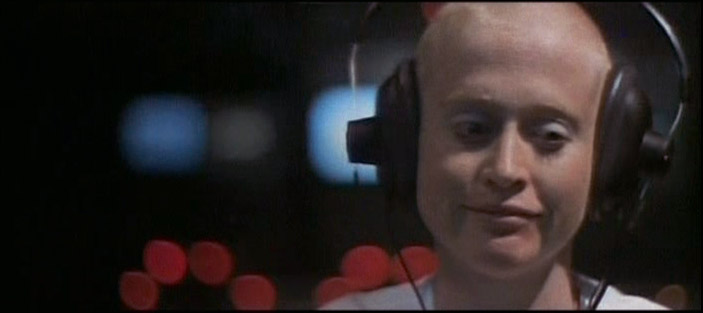
This editing highlights the lyrical "tone poem" style of the original cut, pulling us into the film's weird world, as the characters go through a typical day. It's quite hypnotic and effective, but Lucas apparently felt it was lacking in focus. Indeed, the only thing we can infer from the above sequence is that LUH and SEN work together in some sort of monitoring station, and that THX is in some sort of distress. We get a sense of their personalities, but not of their motivations.
In the new cut, the above sequence is changed:
We start with SEN viewing some computer monitors with THX and LUH on them. Why he's watching them, we don't know, but he looks menacing, and this establishes him as a dubious figure at best.


We then go back to LUH at her monitors, where she's also apparently watching THX at work. (Note the added green lights behind her -- a minor change.)


Then we cut to THX at his job.


Then back to LUH monitoring THX (and in keeping with what I said before, SEN has been replaced from the original shot), which then changes to her responding to a consumer complaining about a product he's bought.
LUH presses a button and he's informed that, for "more enjoyment and greater efficiency", his product will no longer do the thing he wants it to.

We then cut to a new CGI shot of THX's workplace (replacing the first shot in the old version), and then see him apparently in distress.


We drift back across a bank of monitors in the monitoring station, this time showing a child poking around in a medicine cabinet, with an automated voice stating, "If you feel you are not properly sedated, call 348-844 immediately. Failure to do so may result in prosecution for criminal drug evasion." We then see LUH looking maternally at the monitors.

We then cut to THX at work again, before cutting back to LUH looking bored at work.


Now we see the "illegal sexual activity", but instead of showing SEN's reaction to it, we see LUH's.


She looks confused, and then she suddenly she jolts to life as sirens start going off. (At this point both versions then converge on the "radiation leak" sequence.)
In the new edit, we now have more things to mentally chew on: SEN is apparently monitoring both LUH and THX. Is he in a position of power over the both of them? Is he infatuated with them? Is he suspicious of them?
LUH apparently works in some sort of call center, helping those who need assistance, rather than in a position of security. She also has some reason for monitoring THX (could it be personal?), and seems more emotional than the world around her.
We see THX is in distress, as before.
It's a more traditional introduction to the main characters than the 1970 version, but it's still very unusual.
The last shot of LUH watching the sexual activity also shows that perhaps something isn't quite right insider her, either, and she looks seriously perturbed at the sound of an alarm going off. Not nearly as emotionally dead as the world around her.

Radiation Leak
Just as soon as both versions converge, we diverge again. Lots of new footage was added for the radiation leak sequence in the 2004 edition. The 1970 edition starts off with the following montage:


We then see a series of explosions through the eyes of these monitors.

The 2004 version changes this:
We begin with the monitors, but now there's lots of new footage on them, of people fleeing the meltdown.

We now also see LUH's reaction, apparently affected by all the deaths in the way those around here are not. (Note the added lights in the background have now turned red.)

A completely new shot.

Then both versions re-converge again:
Same shot, but now there's new footage on the left monitor.

More people and detail are added behind THX, expanding the world.
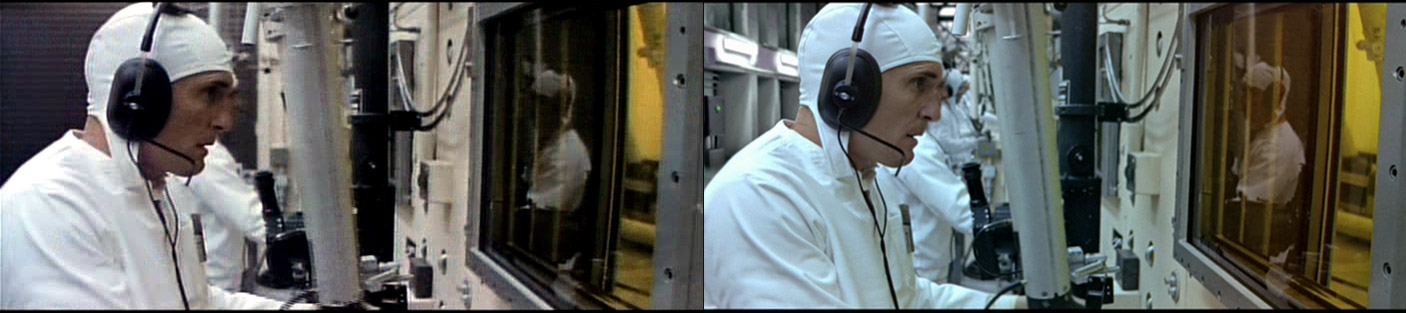
The next two shots are identical in both versions, but are included for completeness.


The next change happens when LUH glances over to her right (green lights again!)...

...to a shot of SEN looking back at her. This has been replaced with her watching THX amid the explosions in the other sector for the 2004 edition.

The next shots just add more detail and depth to THX's working environment (and to Lucas's credit, it's very well done).


Most of these changes increase the sense of danger and scope of the meltdown, but there's also more of a feeling that LUH is emotionally affected by these deaths, and that she is especially concerned about the well-being of THX.
Both versions juxtapose the brutality of the leak with the cold and emotionless reaction by the rest of the complex. Yes there was an explosion, lots of people died, but your shift is over now. See ya 9am tomorrow!
Shift Over... It's Shoppy Time!
The next scenes plays out the same in both versions, but with some world expanding and aesthetic changes made for the 2004 version:THX leaves work, goes shopping for a random red object, and then, apparently burdened by something, goes to "confession" with the computerised religious figure, OMM. During his unburdening to the emotionless OMM, he reveals that he and his "partner" seem to be having problems, but he doesn't know why.
These are the only visuals that are changed (some of them are very clever in how they use the original footage -- look closely -- but they only increase the size of the world, or help establish a more cohesive world aesthetic).


Coming up in Part 2: Robert Duvall goes home and watches porn.


